

Electrospinning for Filtration and Nanofiber Membranes
Electrospinning for Filtration and Nanofiber Membranes
Electrospun nanofiber membranes are used to create thin, high-surface-area functional layers for air filtration, HVAC media, respiratory filtration, industrial dust collection and specialty membrane applications. This guide explains the technical design variables, filtration mechanisms, formulation considerations, scale-up risks and Inovenso routes for proof of concept, pilot production, contract manufacturing or equipment investment.
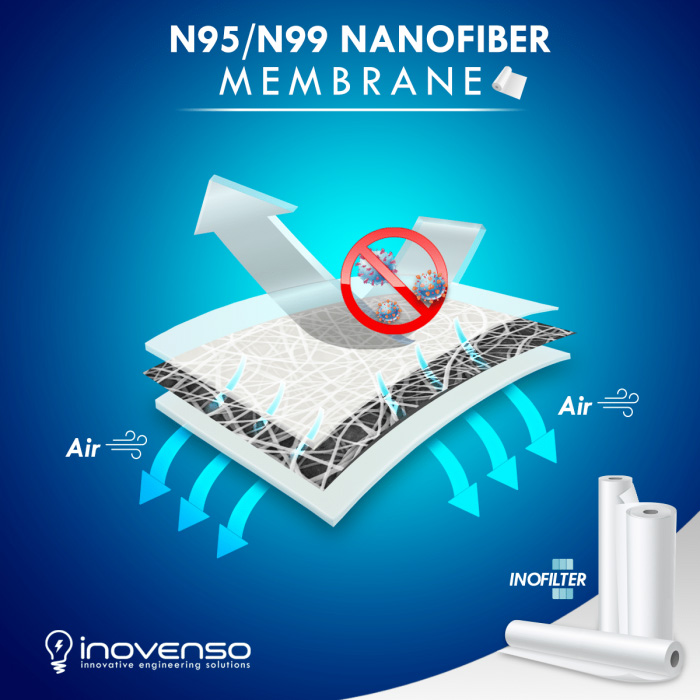
Technical overview: why nanofibers are valuable in filtration
In filtration media, electrospinning is typically used to deposit a thin nanofiber layer onto a mechanically stronger substrate. The nanofiber layer provides fine-scale particle capture, while the substrate provides handling strength, pleatability, dimensional stability and processability.
Conventional fibrous filters often rely on relatively thick layers of microfibers to achieve high particle collection. That approach can increase air resistance. Electrospun nanofiber layers offer a different design route: a very thin coating with small fiber diameters and high surface area can improve capture probability without adding the same bulk thickness as a conventional fiber mat. The commercial challenge is to keep this layer uniform, mechanically stable and reproducible over the full media width.
A useful filtration membrane is not simply the membrane with the smallest fiber diameter. If the fiber layer is too dense, pressure drop may become too high. If it is too open or non-uniform, pinholes or weak spots may reduce filtration efficiency. If the layer is poorly bonded to the substrate, downstream converting, pleating or handling can damage the active layer. Therefore, filtration electrospinning must be treated as a coupled material-process-product problem.
Typical engineering goal
The goal is to produce a membrane architecture that reaches the required filtration performance while maintaining acceptable mechanical robustness, substrate compatibility and production repeatability. In practice, this means selecting the polymer, solvent system, fiber morphology, nanofiber basis weight, substrate, collector architecture and production width together.
Thin active layer
A nanofiber coating can act as the functional capture layer while the substrate carries mechanical load.
High surface area
Small fiber diameters increase available surface area for particle interaction and functionalization.
Tunable morphology
Fiber diameter, bead content, porosity and layer thickness can be tuned by solution and process parameters.
Scale-up sensitivity
Uniformity, substrate charge, solvent evaporation and web handling become critical during roll-to-roll coating.
Filtration mechanisms relevant to electrospun nanofiber media
Particle capture in fibrous filters is not simple sieving. Depending on particle size, flow velocity, fiber diameter and surface charge, different mechanisms dominate.
Electrospinning formulation and process variables
The same polymer can produce very different filtration layers depending on solvent, concentration, conductivity, humidity, flow rate, voltage and collector conditions.
Choose your filtration development path
Inovenso can support filtration projects through proof of concept, feasibility studies, pilot production, contract manufacturing or in-house equipment configuration.
Proof of Concept & Feasibility
For customers who have a filtration target but need to test whether electrospinning can create the required morphology and performance window.
- Polymer and solvent screening
- Fiber morphology development
- Substrate compatibility testing
- Early filtration performance direction
Pilot Production & Sample Batches
For customers who need prototype filter media, sample rolls or validation batches before investing in pilot or industrial electrospinning equipment.
- Sample membrane development
- Pilot roll validation
- Target GSM and width evaluation
- Scale-up risk reduction
Equipment for In-House Production
For customers who want to build internal lab, pilot or industrial capability for filtration membrane development and nanofiber media production.
- Lab-scale electrospinning systems
- Pilot validation lines
- Industrial roll-to-roll production
- Application-specific configuration
Recommended Inovenso route for filtration projects
The right path depends on your development stage. Some customers need a feasibility study before equipment; others already have a validated recipe and need pilot or industrial scale-up.
| Customer situation | Recommended path | Typical Inovenso support |
|---|---|---|
| I have a filtration idea but no validated formulation | PoC / Feasibility Service | Polymer screening, morphology development and substrate compatibility assessment. |
| I have a lab recipe and need prototype filter media | Pilot Production | Sample membrane production, small batches and early validation rolls. |
| I want to perform filtration R&D in my own lab | Lab-Scale Equipment | NanoSpinner24, NE300, NE200 or other lab-scale configurations. |
| I need wider validation before industrial investment | Pilot Line | PE-300, PE-550 or StreamSpinner550 depending on architecture and substrate. |
| I need continuous nanofiber filter media production | Industrial Production Line | StreamSpinner1000, StreamSpinner1600, PE-3550 or custom industrial line configuration. |
| I want Inovenso to manufacture the media for me | Contract Manufacturing | Application-specific nanofiber product development and manufacturing support. |
Recommended Inovenso systems and services for filtration
Filtration projects can start as a service project, continue as pilot validation and later move into in-house lab, pilot or industrial production equipment.

Lab-Scale Electrospinning Systems
For filtration R&D teams developing polymer formulations, fiber morphology, substrate compatibility and early membrane samples inside their own laboratory.

Pilot Electrospinning Lines
For companies that need wider validation rolls, prototype batches or larger filtration media samples before moving into industrial production.

Industrial Nanofiber Filtration Lines
For customers targeting continuous nanofiber filter media production, roll-to-roll manufacturing, HVAC media, respiratory filtration or industrial filtration products.

R&D, Pilot Production and Contract Manufacturing
For companies that want Inovenso to develop the formulation, produce proof-of-concept samples, validate pilot batches or manufacture nanofiber filtration media before equipment investment.
A practical filtration scale-up workflow
A successful filtration project usually moves through a structured path from material screening to prototype media, pilot validation and production planning.
Define performance target
Clarify filtration efficiency, pressure drop, substrate type, airflow and product environment.
Develop formulation
Screen polymer, solvent, concentration, viscosity, conductivity and process window.
Create PoC samples
Produce first membrane samples and evaluate morphology, adhesion, uniformity and basic performance.
Validate on substrate
Move from small samples to real filter substrates, wider media and application-relevant conditions.
Plan pilot production
Define coating width, GSM, web speed, roll length and sample batch requirements.
Select production route
Choose contract manufacturing, lab equipment, pilot line or industrial roll-to-roll system.
Selected technical references
The following external publications provide useful background on electrospun nanofiber filtration, filtration mechanisms and nanofiber membrane development.
- Zhou Y. et al., Electrospun Nanofiber Membranes for Air Filtration: A Review, Nanomaterials, 2022.
- Lee S. et al., Modeling pressure drop values across ultra-thin nanofiber filters with various ranges of filtration parameters under an aerodynamic slip effect, Scientific Reports, 2023.
- Mamun A. et al., Electrospun Nanofiber Mats for Filtering Applications, 2021.
- Subrahmanya T. M. et al., A review of recent progress in polymeric electrospun nanofiber membranes, 2021.
- Kim S. C. et al., Nanofiber Filter Performance Improvement, Aerosol and Air Quality Research, 2020.
- Aflaha R. et al., Crafting high-temperature stable and hydrophobic electrospun nanofiber-based particulate matter filtration membranes, Communications Materials, 2025.
Request a filtration electrospinning consultation
Tell us whether you need proof of concept, sample production, contract manufacturing or equipment recommendation for your filtration application.
- Proof of concept and feasibility studies
- Nanofiber membrane sample development
- Pilot production and validation batches
- Lab, pilot or industrial electrospinning system recommendation
- Contract manufacturing and application-specific production support
Start your filtration project
Please share your target filter application, polymer/solvent system, substrate, target GSM, filtration performance goal and whether you are interested in services, equipment or both.