

Electrospinning for Biomedical Scaffolds and Wound Dressings
Electrospinning for Biomedical Scaffolds and Wound Dressings
Electrospun nanofibers are widely studied for biomedical scaffolds, wound dressing development, localized drug delivery, tissue engineering models and regenerative medicine research. This guide explains the technical design variables, material considerations, development risks and Inovenso routes for proof of concept, sample development, pilot validation or lab-scale equipment investment.

Technical overview: why electrospun nanofibers are used in biomedical R&D
Electrospinning can generate micro- and nanoscale fibrous structures that resemble key physical features of the extracellular matrix. This makes the technology useful for scaffold development, wound dressing research, localized delivery platforms and tissue engineering studies.
Many biological tissues are supported by fibrous extracellular matrix structures. Electrospun nanofiber mats can be engineered with controlled fiber diameter, porosity, orientation, thickness and surface properties. These properties make them attractive for researchers who need a physical scaffold that can support cell interaction, moisture management, active loading or tissue-specific architecture.
Biomedical electrospinning is not simply a matter of producing small fibers. For wound dressings, the nanofiber mat may need to manage exudate, support moisture balance, carry antimicrobial or therapeutic agents and remain mechanically stable during handling. For tissue engineering, the scaffold may need specific porosity, degradation behavior, mechanical integrity, fiber alignment or biochemical functionality.
Typical engineering goal
The goal is to create a nanofiber architecture that matches the biological and mechanical requirements of the application while remaining reproducible and manufacturable. This usually requires coordinated decisions about polymer selection, solvent system, active ingredient loading, collector geometry, fiber alignment, environmental control and post-processing.
ECM-like structure
Electrospun mats can reproduce fibrous architectures similar to extracellular matrix environments.
High surface area
Fine fibers provide a large contact area for cell interaction, surface modification or active loading.
Tunable fiber design
Fiber diameter, porosity, alignment and mat thickness can be tuned by material and process parameters.
Multiple loading strategies
Active molecules can be incorporated by blend, emulsion, surface treatment or coaxial electrospinning.
Biomedical application areas for electrospun nanofibers
Electrospinning is used across multiple biomedical research areas. Each application requires different design priorities and validation methods.
Wound dressing development
Nanofiber dressings can be designed for moisture balance, breathability, active loading, exudate management, antimicrobial research and tissue-supporting structure.
- Biocompatible polymer screening
- Antimicrobial or bioactive loading
- Exudate and moisture management
- Handling and dressing integrity
Tissue engineering scaffolds
Electrospun scaffolds can support research into cell attachment, alignment, migration, differentiation and tissue-specific matrix architecture.
- Random or aligned fiber scaffolds
- Porosity and pore interconnectivity
- Degradation rate control
- Mechanical property tuning
Drug-loaded nanofiber mats
Bioactive molecules can be incorporated into electrospun structures for release studies, localized therapy concepts or prototype delivery platforms.
- Blend electrospinning
- Coaxial/core-shell structures
- Release profile development
- Active stability considerations
Key design parameters for biomedical electrospinning projects
Biomedical nanofiber development requires coordinated optimization of morphology, materials, mechanical behavior, bioactivity, processing conditions and intended development pathway.
Formulation and process variables
Biomedical electrospinning is sensitive to both solution chemistry and environmental conditions. Small formulation changes can alter fiber morphology, release behavior and scaffold performance.
Nanofiber architecture options for biomedical development
The required architecture depends on whether the goal is wound coverage, active delivery, tissue guidance, barrier formation or scaffold-based tissue regeneration.
Random nanofiber scaffolds
Random fiber mats are useful for general scaffold and wound dressing concepts where isotropic structure and broad surface coverage are preferred.
- Simple morphology development
- Wound dressing prototypes
- Barrier or matrix-like structures
Aligned or oriented fibers
Aligned fibers can be used when directional cell behavior, anisotropic mechanical properties or tissue-specific architecture are important.
- Neural and musculoskeletal research
- Directional cell guidance
- Rotating drum or shaft collection
Coaxial electrospun fibers
Coaxial electrospinning can produce core-shell fibers for active protection, controlled release or separation of incompatible materials.
- Drug-loaded core structures
- Reduced burst release studies
- Bicomponent or hollow fiber concepts
Choose your biomedical development path
Inovenso can support biomedical nanofiber projects through proof of concept, feasibility studies, prototype sample production or in-house equipment configuration.
Proof of Concept & Feasibility
For teams that have a biomedical concept but need to test whether electrospinning can create the required morphology, structure and material behavior.
- Polymer and solvent screening
- Fiber morphology development
- Collector and architecture selection
- Early prototype feasibility
Prototype Samples & Pilot Validation
For customers who need wound dressing prototypes, scaffold samples, drug-loaded mats or validation batches before investing in their own electrospinning equipment.
- Prototype nanofiber mat development
- Small batch sample production
- Coaxial or aligned fiber trials
- Scale-up risk assessment
Equipment for In-House Biomedical R&D
For laboratories and companies that want to develop biomedical nanofiber scaffolds, wound dressings or drug delivery structures internally.
- Lab-scale electrospinning systems
- Coaxial and bicomponent options
- Climate and camera modules
- Collector configuration support
Recommended Inovenso route for biomedical projects
The right route depends on your development stage, target application and whether you need service work, sample production or an electrospinning system for internal R&D.
| Customer situation | Recommended path | Typical Inovenso support |
|---|---|---|
| I have a biomedical idea but no validated electrospinning formulation | PoC / Feasibility Service | Polymer screening, solvent selection, morphology development and early sample trials. |
| I need wound dressing or scaffold prototype samples | Prototype Sample Development | Nanofiber mat production, architecture selection and application-specific sample preparation. |
| I need drug-loaded or core-shell fibers for R&D | Coaxial / Bicomponent Development | Core-shell feasibility, active loading strategy and release-oriented process development. |
| I want to perform biomedical electrospinning inside my own lab | Lab-Scale Equipment | NanoSpinner24, NE300, NE200, NE100 or NanoSpinner Plus configuration. |
| I need wider validation or pre-production capability | Pilot Equipment / Validation | PE-300, PE-550 or application-specific pilot configuration depending on process maturity. |
| I am not sure whether service or equipment is the right path | Application Consultation | Review of target product, polymer/solvent, regulatory stage and development roadmap. |
Recommended Inovenso systems and services for biomedical electrospinning
Biomedical projects can start with Inovenso R&D services, continue with prototype sample development and later move into in-house lab-scale or pilot-scale equipment.
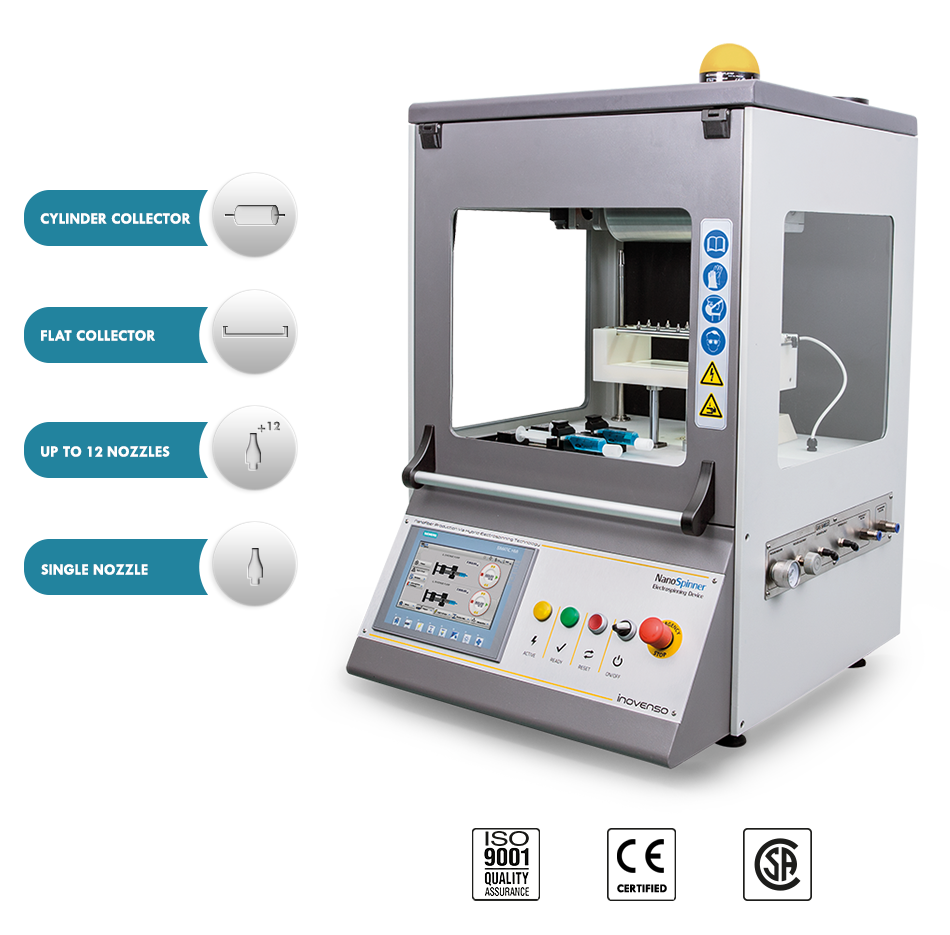
NanoSpinner24 and NE Series
For biomedical R&D teams developing scaffold morphology, wound dressing prototypes, aligned fibers, coaxial drug-loaded fibers or controlled laboratory workflows.
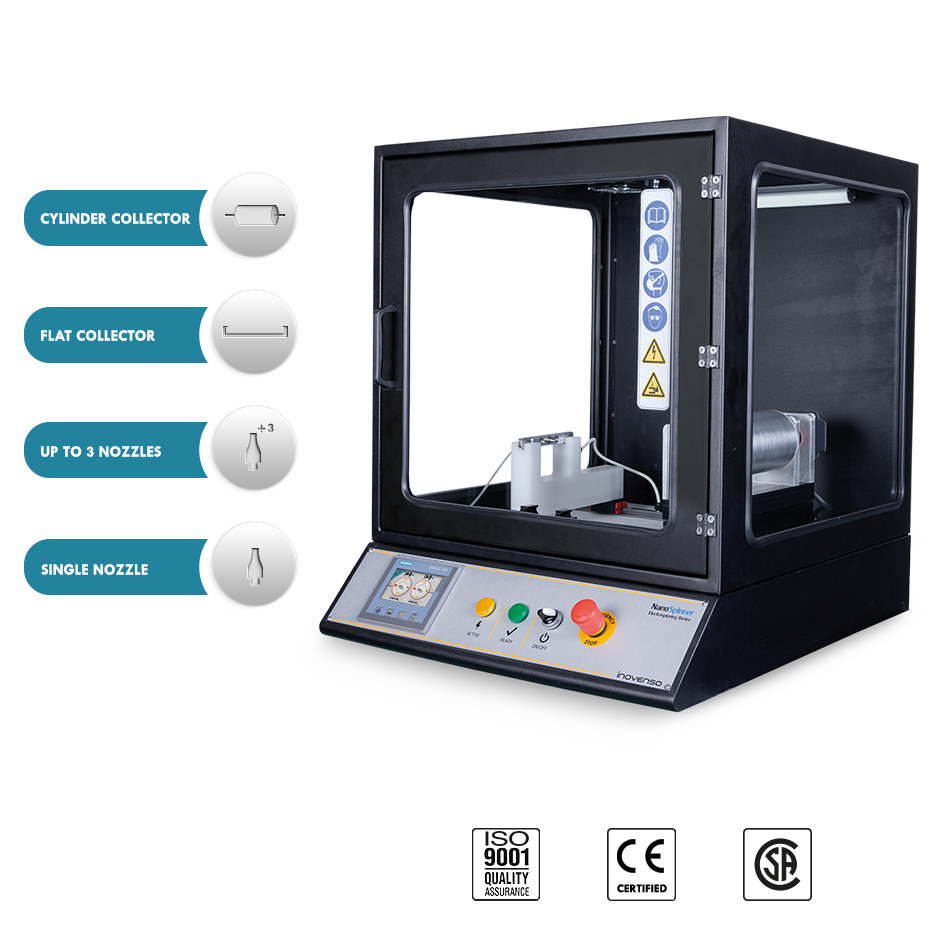
NanoSpinner Plus, NS1 and Starter Systems
For early-stage academic or industrial teams that need to begin biomedical electrospinning experiments with a compact and accessible configuration.

PE-300, PE-550 and Pilot Systems
For companies moving from lab coupon samples to larger prototype mats, validation batches or pre-production nanofiber material development.

R&D, Prototype Samples and Application Development
For teams that want Inovenso to develop the formulation, produce proof-of-concept samples, validate nanofiber morphology or recommend a suitable equipment configuration.
Useful modules for biomedical electrospinning workflows
Biomedical applications often require specific collectors, process control or fiber architecture options. These modules can be considered during equipment configuration.
Coaxial / Bicomponent System
For core-shell fibers, active protection, dual-material structures, controlled release studies and advanced drug delivery research.
Rotating Drum or Shaft Collector
For aligned fibers, tubular structures, wound dressing supports, scaffold orientation studies and tissue-specific architecture development.
Climate Control and Camera Integration
For repeatable solvent evaporation, humidity-sensitive formulations, visual monitoring and controlled R&D documentation.
A practical biomedical nanofiber development workflow
A biomedical electrospinning project should move from material screening to morphology optimization, prototype testing and a clearly defined service or equipment route.
Define the application
Clarify whether the goal is wound dressing, scaffold, drug delivery, tissue model or another R&D use.
Select materials
Choose polymer, solvent, active ingredient and target degradation or hydration behavior.
Develop morphology
Optimize fiber diameter, bead formation, porosity, alignment, mat thickness and collector setup.
Create prototype samples
Produce initial nanofiber mats and evaluate morphology, handling, moisture behavior and structure.
Plan characterization
Define SEM, mechanical, contact angle, release profile, degradation and biocompatibility testing needs.
Select the route
Continue with Inovenso R&D service, request pilot validation or configure in-house equipment.
Selected technical references
The following external publications provide useful background on electrospun nanofibers for wound healing, biomedical scaffolds, drug delivery and coaxial electrospinning.
- Liu X. et al., Electrospun Medicated Nanofibers for Wound Healing: Review, 2021.
- Bhattarai R. S. et al., Biomedical Applications of Electrospun Nanofibers, 2018.
- Pant B. et al., Drug Delivery Applications of Core-Sheath Nanofibers Prepared by Coaxial Electrospinning, 2019.
- McClellan P. et al., Recent Applications of Coaxial and Emulsion Electrospinning Methods in the Field of Tissue Engineering, 2016.
- John J. V. et al., Electrospun Nanofibers for Wound Management, 2021.
- Azari A. et al., Electrospun Polycaprolactone Nanofibers: Current Research and Applications in Biomedical Applications, 2021.
Request a biomedical electrospinning consultation
Tell us whether you need proof of concept, prototype sample development, pilot validation or equipment recommendation for your biomedical nanofiber application.
- Wound dressing and scaffold proof-of-concept studies
- Drug-loaded, coaxial or bicomponent nanofiber feasibility
- Prototype sample development and pilot validation
- Lab-scale electrospinning system recommendation
- Collector, climate control and process configuration support
Start your biomedical nanofiber project
Please share your target application, polymer/solvent system, active ingredient if applicable, desired fiber architecture, current development stage and whether you are interested in services, equipment or both.