From Palm-Size to Roll-to-Roll, Lab to Industrial: A Practical Scale-Up Roadmap for Nanofiber Membrane Production via Electrospinning
Why scaling electrospinning is harder than it looks?
Electrospinning is one of those technologies that feels almost “too easy” in a lab. You set up a syringe, a pump, a collector, and a high-voltage supply. In a short time, you can produce a nanofiber membrane that looks excellent under SEM: clean fibers, narrow diameter range, consistent morphology, and promising performance in filtration, biomedical, energy, or functional textile applications.
Then the scale-up attempt begins.
A process that worked at 0.5–2 mL/hour becomes unstable at 20–200 mL/hour with multiple jets. A 10–15 cm wide deposit that looked uniform becomes patchy at 30–50 cm. Solvent odors become solvent hazards. You start seeing beading, fused fibers, wet spots, thickness streaks, and edge-to-center differences. After a few hours, clogging or drift appears. Batch-to-batch repeatability drops. Production teams start losing confidence because “it worked yesterday, but not today.”
This is not unusual. In fact, it’s the typical story when electrospinning leaves R&D and enters even pilot and semi-industrial production, not yet full-scale industrial line. The reason is that electrospinning scale-up is not a simple multiplication of lab settings. It’s a systems engineering and production problem. At industrial scale, the dominant variables are no longer only the “polymer concentration” or “voltage.” Instead, the dominant variables become environmental control, solvent handling, field geometry across width, deposition uniformity, web tension control, cleaning and maintenance architecture, automation, and quality assurance over long continuous runs.
This article is a practical roadmap. It explains why many “great lab nanofibers” fail at pilot or industrial scale, what design patterns make pilot and industrial electrospinning lines work, what “1-meter roll-to-roll” really implies, and what data buyers should demand when vendors claim “easy scaling.” Route to choose the right nanofiber company and machine for scaling up nanofiber membrane production searching for industrial nanofiber production
What is electrospinning scale-up?
Electrospinning scale-up is the transition from laboratory nanofiber formation (often small-batch, short-duration, manual control) to pilot and industrial nanofiber membrane manufacturing (continuous or semi-continuous, multi-hour to multi-day operation, controlled environment, traceable QA/QC). The objective is to increase output without losing the properties that made the lab membrane valuable in the first place.
Practically, scale-up means simultaneously preserving:
- Fiber morphology stability;
Fiber diameter distribution, beading frequency, surface texture, and fiber-to-fiber fusion behavior must remain within specifications or close to achieved levels in lab scale nanofiber production.
- Membrane structure consistency;
Thickness, basis weight (g/m²), porosity distribution, pore size distribution, membrane texture and layer adhesion of nanofibers, need repeatability.
- Functional performance
Filtration efficiency and pressure drop, mechanical strength, wettability, surface chemistry, conductivity, antimicrobial effect, or whatever property the nanofiber product is designed for.
- Reproducibility over time
The process must be stable not for 10 minutes, but for 8 hours or longer, across shifts, operators, and seasons.
In terms of fundamentals, electrospinning is an electrohydrodynamic jet process. A charged polymer solution forms a Taylor cone and ejects a fine jet that stretches and whips while solvent evaporates, leaving solid fibers that deposit on a collector. The physics is known, but the industrialization is hard because small environmental and system variations translate into large morphological changes especially under the high voltage electric fields.
Why many “great lab nanofibers” fail at pilot or industrial scale?
If you want a realistic scale-up roadmap, you have to start with the failure modes. Most scale-up failures are not “mysteries.” They repeat because teams underestimate the shift from lab simplicity to industrial constraints.
- Humidity and climate variability becomes a dominant variable;
In the lab, people often spin in an open room. Humidity might range from 30% to 80% depending on weather, HVAC cycles, or someone opening a window. Many formulations “seem fine” in this environment, especially for short runs.
At pilot and industrial scale, humidity variation becomes a direct quality defect generator. Depending on polymer/solvent system, humidity can trigger:
• Beads or bead-on-string structures
• Ribbon fibers or collapsed pores
• Fiber fusion due to slower evaporation
• Surface roughness changes
• Large shifts in diameter distribution
• Poor adhesion or “powdery” layers
Why does this amplify at scale? Because at scale you need long runs, and long runs experience more environmental drift. Also, wide-area deposition is more sensitive to local airflow and local drying conditions.
Practical requirement: pilot and industrial electrospinning should be done inside controlled chambers with closed-loop temperature and humidity control. A useful target is keeping temperature stable within roughly ±1–2°C and RH within roughly ±2–3% during production, especially for sensitive solvent systems.
- Solvent handling changes from “smell” to “safety + compliance + cost”
In many labs, solvent vapor is treated casually, even when it shouldn’t be. At pilot scale, you move from “a few milliliters evaporating” to liters per shift. This shifts the problem into:
• Worker exposure (health and compliance)
• Flammability and explosion risk
• Ventilation and ATEX/ex-proof requirements
• Solvent purchasing cost
• Solvent disposal and environmental reporting
Industrial electrospinning lines must be designed with solvent-aware architecture: controlled exhaust paths, vapor monitoring, safe electrical design, and ideally solvent recovery. Solvent recovery is not only an ESG story; it’s also a TCO story because solvent becomes an ongoing OPEX line item.
What to demand from a scale-up system:
• Clear airflow and exhaust design (not “optional hose”)
• Compatibility with relevant safety standards for your solvent class
• Solvent capture/recovery options if solvent usage is high or dangerous or expensive.
- Collector design that works in the lab often fails in production.
A static flat plate collector is fine for proof of concept. It’s rarely fine for membrane manufacturing. The collector is not just “where fibers land.” It defines:
• Electric field geometry and stability
• Deposition footprint shape
• Layer build-up behavior
• Membrane removal method
• Substrate compatibility
• Uniformity across width
Pilot and industrial designs typically use rotating drums, moving belts, or continuous web substrates. Each introduces new variables: speed, tension, grounding quality, edge effects, and cleaning requirements.
A common failure pattern: the lab membrane looks good because you collect on aluminum foil and peel it off carefully. In production, you want continuous collection onto a substrate film or nonwoven. Suddenly adhesion changes, and the membrane either doesn’t stick reliably or sticks too much and tears. This is not “bad electrospinning.” It’s the reality of manufacturing.
- Deposition uniformity becomes the most expensive problem
Industrial nanofiber membranes are judged by uniformity. Most customers care less about “the best SEM image in the middle” and more about “minimum specs across the entire roll.”
Non-uniformity shows up as:
• Center-to-edge thickness differences
• Stripes or banding from jet density variation
• Local thin spots causing mechanical weakness
• Local thick spots causing pressure drop or performance drift
• Variable basis weight leading to inconsistent downstream lamination
Uniformity is where machine architecture matters most. It’s also where many “easy scaling” marketing claims collapse if you demand data.
- Multi-hour stability reveals drift that short lab runs hide.
A lot of lab electrospinning is done in short cycles: 10–60 minutes. In industrial settings you want 8–24 hours of stable output. Over long runs, new effects appear:
• Polymer viscosity drifts as solvent evaporates from reservoirs
• Pump flow accuracy matters more (small errors integrate over time)
• Temperature and humidity changes affect viscosity and evaporation
• Spinnerets/nozzles clog gradually
• Solution aging can cause phase separation
• Electrical charging conditions change as deposits accumulate
If a vendor’s “industrial demo” is 15 minutes, it’s not an industrial demo. A serious scale-up demo is hours long, with QC sampling across time.
Pilot and industrial line electrospinning design patterns.
There are many machine styles, but successful scale-up systems share design patterns. If you understand these patterns, you can evaluate machines more objectively.
- Continuous substrate winding and web handling.
Industrial membrane production usually means depositing onto a moving substrate (film, nonwoven, textile, mesh, paper). This requires a web handling system that controls:
• Unwind and rewind speed
• Web tension (closed-loop)
• Edge guiding
• Wrinkle prevention
• Substrate grounding consistency
This is not a “nice to have.” At 1-meter width, web handling is a major discipline by itself. If web tension fluctuates, membrane thickness fluctuates. If the web wrinkles, you get local over-deposition. If edge guiding is weak, your membrane edges wander and become unusable.
What to demand:
• Load cell-based tension control (closed-loop)
• Edge guide system suitable for your substrate
• Clear specification of tension stability and speed range
• Demonstrated performance at your target width and speed
- Controlled nozzle-to-collector distance and geometry automation.
The nozzle-to-collector distance is a core parameter in lab electrospinning. In industrial scale-up, you need it to be repeatable and often adjustable by recipe, because products differ.
An industrial system should offer:
• Motorized distance adjustment (Z-axis) on screen in mm precision
• Repeatable field geometry
• Recipe storage for distance + voltage + flow + speed
• Safety interlocks and position feedback
Manual knob-based adjustments are not appropriate for production if you need reproducibility.
- Programmable process control and data logging
In manufacturing, you don’t just “set the knobs.” You need recipes and traceability. Industrial electrospinning should support:
• PLC or industrial controller-based recipes
• Real-time monitoring of flow rate, voltage, current, chamber climate
• Alarm conditions and automatic safe stop
• Data logging for QA documentation and audits
This matters because customers will ask: “How do you guarantee repeatability?” The real answer is not “we have skilled operators.” The answer is “we have a controlled process with recorded parameters.”
- Cleaning and maintenance architecture (often ignored until it kills uptime)
Industrial electrospinning is a “maintenance process.” Residues happen. Clogging happens. Deposits build up. A system that is hard to clean will cost you more than it saved in CAPEX. It’s a production. Not a lab research. There will be some mass to clean up during process.
Industrial design patterns include:
• Modular spinning heads that can be removed quickly
• Quick-change spinnerets/nozzles
• Solvent-resistant chamber materials
• Drainage and cleaning access
• Defined cleaning SOP and estimated downtime per cleaning cycle
What to demand:
• A realistic cleaning schedule (not “rarely needed”)
• The time required to return to stable production after cleaning
• Spare part lists and typical lead times
Industrial roll-to-roll manufacturing: what “1-meter width continuous electrospinning” really implies
“1-meter roll-to-roll electrospinning” is one of the most searched phrases in industrial nanofiber production. It is also one of the most misunderstood.
A 1-meter width line implies that you are no longer dealing with “nanofibers only.” You are dealing with a complete manufacturing line where nanofiber deposition is only one module.
Here’s what it implies in practice.
- Quality control must become statistical, not visual
At lab scale, you inspect a membrane visually and do occasional SEM checks. At industrial scale, you need QC systems that give repeatable metrics:
• Basis weight (g/m²) across width and length
• Thickness distribution
• Mechanical tensile strength sampling strategy
• Air permeability and pressure drop testing
• Defect mapping (holes, thin streaks, edge issues)
In many industries, buyers will ask for a defined QC plan: how often you sample, where you sample across width, and what acceptance limits you enforce. However, in general, buyers should define their own QC standards according to their final product and expectations.
- Cross-width uniformity becomes the product, not just a parameter
Your customer will judge the worst part of the roll, not the best. That means you must think in terms of:
• Maximum deviation from average across width
• Maximum deviation over time
• Consistency between rolls
If a machine cannot hold uniformity across 1 meter, it doesn’t matter that its center looks perfect.
- Web tension and winding quality directly affects membrane consistency
Tension control is not just a “mechanical issue.” It changes deposition thickness and layer density. It also impacts downstream processing like lamination, cutting, and packaging.
- The electric field must be stable across a large geometry
Industrial width means larger electrodes, longer distances, more complex grounding, high tech insulation solutions and more sensitivity to geometry. Field instability can cause:
• “Hot zones” with over-deposition of nanofibers
• “Dead zones” with low deposition of nanofibers
• Non-uniform fiber charging leading to nanofiber morphology differences
This is where machine design differentiates suppliers. Field engineering is not visible in a brochure, but it is visible in uniformity data.
- Long-duration production becomes the real proof
A real industrial line should demonstrate stable output over hours. Ideally, the supplier can show multi-hour or multi-shift production data (even if not public, at least in controlled NDA demonstrations).
Competitive comparison: “easy scaling” claims and what’s realistic across vendor classes
In the market, you’ll see different “classes” of electrospinning solutions, commonly associated with well-known groups in EU and USA and Turkey manufacturers offerings (and similar categories). The key is not brand names; it’s what class of architecture you’re evaluating and what data supports the claims.
Many vendors claim:
• “Easy scaling”
• “Industrial ready”
• “High throughput”
• “Uniform deposition”
Those claims are meaningless unless they come with specific, comparable data.
Here is what buyers should ask for, split into technical proof, scalability proof, and commercial/operational proof.
A) Technical proof buyers should request
- Throughput, expressed clearly
Ask for g/hour of nanofiber, or m²/hour of membrane at a defined basis weight for each polymer type and solution recipe. If they only provide “high throughput” without conditions, it’s not comparable.
- Uniformity across width
Ask for thickness or basis weight variation (%) across width, measured at multiple points. Ask how many points and how often. Ask for air permeability change across width.
- Nanofiber diameter statistics
Ask for SEM-based diameter distribution with mean and standard deviation, plus beading frequency, not just a single “nice photo.”
- Continuous run duration
Ask for evidence of stable operation over at least several hours. A 15–30 minute demo is not industrial validation. At least several hours continuous run means it can produce industrial size membranes.
- Solvent management and consumption rate
Ask for solvent loss per hour at production throughput, and whether recovery is possible. Buyers can build their own solvent recovery systems.
- Installation needs.
Ask for energy usage and lines and grounding needs with data, installation guide for the placing the machine, dimensions and weight of machine etc.
B) Scalability proof buyers should request
- Upgrade path and modularity
Can you start at pilot width and later upgrade to 1 meter nanofiber production? Or do you need to replace the entire machine?
- Automation and recipe control
Can the system store recipes and maintain repeatability across operators?
- Spare parts and maintenance design
What clogs? What wears? How long does cleaning take? What are spare lead times? Ask more learn more. It’s a new technology.
C) Commercial and operational proof buyers should request
- After-sales support structure
Where is service based? What is the response time? Is remote support included? Is on-site training included?
- Installation requirements and facility integration
What does the chamber require? HVAC? Exhaust? Solvent compliance? Electrical requirements?
- International logistics and taxes
Industrial lines are heavy and large. Import taxes, shipping, and installation costs can be significant. Buyers should budget for full delivered cost, not only equipment price.
- Total cost of ownership (TCO)
Calculate TCO across: solvent, energy, maintenance downtime, spare parts, training, and yields (scrap/reject rates). A cheaper line with low yield can be more expensive than a premium line with high yield.

A practical scale-up roadmap: from lab to pilot to industrial roll-to-roll nanofiber production
A reliable scale-up journey is staged. The biggest mistake is skipping stages because the lab membrane “looks good.”
Stage 1: Lab validation (palm-size output)
Goal: prove the material, polymer solution recipe and define the process window.
What you must finish here in the first stage:
• Identify stable polymer concentration and solvent ratio
• Establish voltage, flowrate, and distance ranges where fibers are consistent
• Understand sensitivity to humidity and temperature and define optimum atmosphere conditions for your polymer solution
• Define target membrane basis weight and thickness
• Collect baseline SEM + performance data (filtration, tensile, etc.)
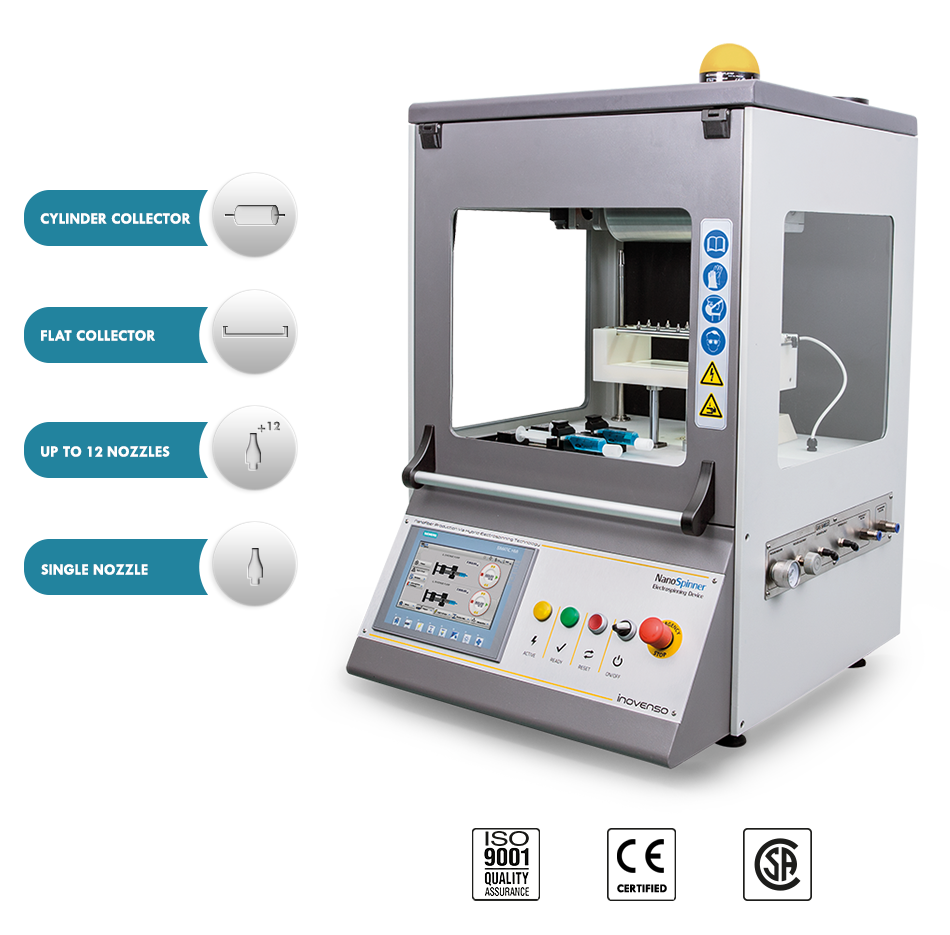
Lab platforms are designed for process development, formulation testing, and repeatable R&D work. Inovenso’s lab-scale electrospinning systems, including the Nanospinner electrospinning machines and related laboratory accessories and equipment, are developed and optimized to support reliable and user-friendly nanofiber research. Their performance and usability are demonstrated by adoption at more than 600 research centers, universities, and companies worldwide.
Stage 2: Pre-pilot or benchtop-to-pilot transition in nanofiber production
Goal: make the process repeatable and begin thinking like a manufacturer.
What you must prove:
- Repeatability over multiple days
- Early uniformity improvement (wider collector or controlled deposition area)
- Substrate compatibility (if membrane must be produced on a support)
- Basic environmental control strategy (at least stable humidity/temperature)
- Solution recipe stability
Key risks to manage:
• Drift in polymer solution viscosity due to solvent evaporation
• Early signs of clogging and cleaning frequency of feeding parts
• Safety considerations for increased solvent vapor
Stage 3: Pilot line or Semi-Industrial Electrospinning Lines (often 30–50 cm class)
Goal: Simulate and validate continuous nanofiber production logic.
What you must prove:
• Continuous substrate feeding and winding
• Multi-hour run stability
• Repeatable basis weight control
• QC sampling plan across width and time
• Documented cleaning and uptime
This stage is where many projects either become real or fail. If you can produce pilot rolls with predictable metrics and low scrap, industrial scale becomes a business decision rather than a scientific gamble.
Inovenso’s pilot and scale-up electrospinning solutions, together with its process development support, play a critical role in transitioning R&D work toward industrial-scale production. Even if you have already moved into industrial manufacturing, semi-industrial and pilot-scale systems remain highly valuable for developing new polymer formulations, validating process parameters, and safely adapting new solutions before full-scale industrial implementation.
Stage 4: Industrial roll-to-roll (1 meter and beyond in width)
Goal: Produce sellable product with industrial QA/QC.
What you must have:
• Closed-loop web tension control
• Chamber climate control
• Robust exhaust and solvent handling
• Automation and recipe systems
• Data logging for production traceability
• Defined QC methods and acceptance limits
• Maintenance and spare part planning
Pros and cons: scaling electrospinning to industrial nanofiber production
Pros
• Enables nanofiber membranes with unique porosity and surface area
• Supports functional materials and multi-layer structures
• Can be adapted to filtration, medical, energy, and technical textiles
• Roll-to-roll can create consistent industrial products when engineered properly
Cons
• Environmental sensitivity requires controlled chambers
• Solvent handling can be costly and complex
• Uniformity across width is difficult without robust field engineering
• Maintenance and cleaning can reduce uptime if not designed well
• Scaling claims often exceed reality unless backed by data
Scale-Based Comparison of Benefits and Challenges in Electrospinning Systems
| Aspect | Advantage | Challenge |
| Lab Systems | Low investment | Limited throughput |
| Pilot Systems | Process validation | Moderate complexity |
| Industrial Systems | Continuous production | High engineering demand |
| Roll-to-Roll | Scalable membrane output | Complex web control |
| Automation | Reproducibility | Higher CAPEX |

Structured Technical Comparison Table for Electrospinning Scale-Up: Engineering, Environmental, and Operational Differences from Laboratory Systems to Industrial Nanofiber Production Lines.
A comprehensive analysis of how electrospinning machines evolve across R&D, pilot, and full roll-to-roll industrial nanofiber production stages
| Parameter / Factor | Lab (R&D) | Pilot Scale | Industrial Roll-to-Roll |
| Output Scale | mg/h to low g/h | g/h to early m²/h | Continuous m²/h (full production rolls) |
| Typical Run Duration | 10–60 minutes | 2–8 hours | 8–24 hours (multi-shift operation) |
| Environment | Open room | Controlled enclosure | Closed-loop climate chamber |
| Solvent Handling | Minimal / fume hood | Enhanced exhaust system | Integrated exhaust + optional solvent recovery |
| Collector System | Static plate or small drum | Moving belt or drum | Full web handling + winding with precision tension control |
| Uniformity Focus | Local spot quality | Cross-width validation | Statistical SPC across width and over time |
| Automation Level | Manual parameter adjustment | Partial recipe control | PLC / SCADA recipes + full data logging and automation |
| Maintenance Strategy | Occasional intervention | Scheduled maintenance | Engineered uptime + quick-change modules |
| Quality Control Methods | SEM + basic physical testing | SEM + basis weight mapping | SPC, sampling plans, full traceability records |
| Upgrade / Scalability Path | Limited | Moderate | Must be modular for future capacity expansion |
If you are searching for:
• industrial electrospinning machine manufacturer
• roll-to-roll nanofiber membrane production line
• pilot-to-industrial electrospinning scale-up system
• 1-meter wide electrospinning equipment
• scalable nanofiber manufacturing machines
…then the selection criteria should go beyond brochure throughput claims.
- Engineering depth: does the supplier build scale-up architecture, or only lab equipment?
A serious industrial scale-up supplier should demonstrate competence in:
- electric field engineering across width
- chamber design and climate control
- web handling and winding
- programmable automation and recipe control
- solvent management and facility integration
- serviceability, uptime, and maintainability
- Global references
Inovenso designs and manufactures electrospinning machines across lab, pilot, and industrial scale-up needs for nanofiber membrane production, supporting customers who want to move from R&D nanofiber development to continuous membrane production. For organizations aiming to scale nanofiber membranes to pilot and industrial roll-to-roll production, working with a manufacturer that understands both electrospinning physics and industrial manufacturing constraints reduces risk significantly.

- Proof over promises: demand evidence of long-duration, wide-width uniform production
Ask for:
• cross-width basis weight variation report
• multi-hour run evidence and stability metrics
• consistent product specs across multiple rolls
• documented cleaning schedule and uptime expectation
• solvent handling suggestions, datas and compliance readiness
- Scalability and upgrade path: avoid “dead-end machines”
One of the most expensive mistakes is buying equipment that cannot grow with the project. If you expect to move from 30–50 cm to 1 meter, ask:
• can the machine be upgraded in modules?
• can spinning capacity be expanded without replacing everything? Or attaching new units to line?
• does the automation architecture support new heads and new widths?
• how does service and spare parts scale?
- After-sales support and international readiness
Industrial electrospinning lines are infrastructure. Your selection should account for:
• installation training quality
• remote support capability
• spare parts availability and lead times
• documentation quality (SOPs, wiring diagrams, maintenance manuals)
• experience supporting international customers (logistics, service planning)
- Total cost of ownership: include yield, scrap rate, downtime, and solvent cost
If one line produces 100 m²/day but rejects 25% due to uniformity issues, the real output is 75 m²/day. If cleaning takes 2 hours every shift, the uptime drops. If solvent loss is high, OPEX grows. These are not small details; they define competitiveness.
Qustions and Answers (Q&A)
Q1: Why do nanofibers that look perfect in the lab fail during pilot production?
Because pilot production exposes variables that lab runs often hide: humidity drift, solvent vapor accumulation, field geometry changes across width, substrate/web handling issues, and multi-hour stability challenges such as clogging and viscosity drift. Choose the supplier who has all lab, pilot and industrial scale machines.
Q2: What is the most important requirement for industrial electrospinning scale-up?
Closed-loop process stability. That includes controlled climate (temperature and humidity), stable solution delivery, stable electric field geometry, controlled substrate movement, and a QC system that can verify uniformity across width and time.
Q3: What does “roll-to-roll electrospinning” actually mean in manufacturing terms?
It means nanofibers are deposited continuously onto a moving substrate that is unwound and rewound as a roll, requiring tension control, winding quality, and consistent deposition across the entire web width—often 30 cm, 50 cm, 1 meter, or more.
Q4: What data should I request from electrospinning machine suppliers before purchasing?
At minimum: throughput at defined conditions, cross-width basis weight variation data, fiber diameter distribution statistics, continuous run duration validation, solvent handling/recovery information, energy consumption, maintenance and cleaning schedule, and upgrade path options.
Q5: Is it better to scale using needle-based or needleless electrospinning?
It depends on the product and throughput needs. Needle-based systems may offer precise control but face clogging and scale complexity with many nozzles. Needleless systems can offer higher throughput potential but require strong field engineering and may have different uniformity trade-offs. The right choice should be validated with data at pilot scale. Refer to related articles about those systems to learn more about details.
Q6: How do I plan a safe facility for solvent-based electrospinning at industrial scale?
Plan for controlled exhaust, solvent vapor monitoring, compliant electrical design where required, and ideally solvent recovery for cost and VOC control. Facility requirements should be discussed early with the equipment manufacturer and safety/compliance experts.
Q7: What is a practical scale-up path from lab to 1-meter industrial production?
Lab validation → pre-pilot repeatability → pilot continuous runs (30–50 cm) with QC → industrial roll-to-roll with closed-loop tension, climate, and data logging. Skipping pilot validation increases technical and financial risk.
Conclusion
Scaling nanofiber membrane production via electrospinning from palm-size lab samples to industrial roll-to-roll manufacturing is possible, but it requires disciplined engineering. The biggest risk is assuming that a beautiful lab membrane automatically translates into a stable manufacturing process.
A successful scale-up program focuses on:
• Controlled environment (humidity and temperature stability)
• Solvent-safe architecture and, when needed, recovery
• Collector and field geometry designed for width uniformity
• Web handling and tension control for roll-to-roll consistency
• Automation, recipe control, and data logging for reproducibility
• Maintainability, cleaning design, and uptime planning
• Transparent data from the machine supplier—throughput, uniformity, long-run stability
For teams moving from R&D nanofiber development to pilot and industrial membrane production, choosing a manufacturer with proven scale-up experience, modular upgrade paths, and strong process control architecture is often the difference between a successful industrial product and a stalled pilot project. Review the manufacturer’s history and level of experience carefully. If they provide proven solutions across diverse industrial applications—such as biomedical nanofiber systems, HEPA-grade nanofiber filtration membranes, or comparable high-performance uses—it is a strong indication that their technical expertise is reliable and well established. Inovenso’s electrospinning machine portfolio and scale-up approach are aligned with this reality: moving customers from lab success to industrial nanofiber membrane manufacturing with practical, production-focused engineering.
References