Different Diameter Needles

Different diameter needles offered by Inovenso Ltd assist researchers in utilizing electrohydrodynamic processes i.e., Electro spraying and Electrospinning according to their polymer and solvent properties. Diameter of a needle, more specifically the tip/orifice is the 3-dimensional region where the polymeric solution is accumulated. The polymeric solution protrudes from this region and accumulates here until critical applied potential is reached, and jet is formed and ejected from the surface of the accumulated polymer solution by breaking the surface tension.

Continuous/controlled process: Defining the correct diameter of the needle for a particular polymeric solution results in a continuous and controlled process.

Fiber diameter: The needle diameter/gauge number directly impacts the fiber diameter so the choice of needle diameter helps in achieving a given range of fiber diameter for particular applications.

Versatility: Having different diameters of the needle allows compatibility of the process with various polymer and solution types.

Enhanced efficiency: Since the optimized process from a given needle becomes continuous, there is enhanced efficiency and productivity of the fibers.

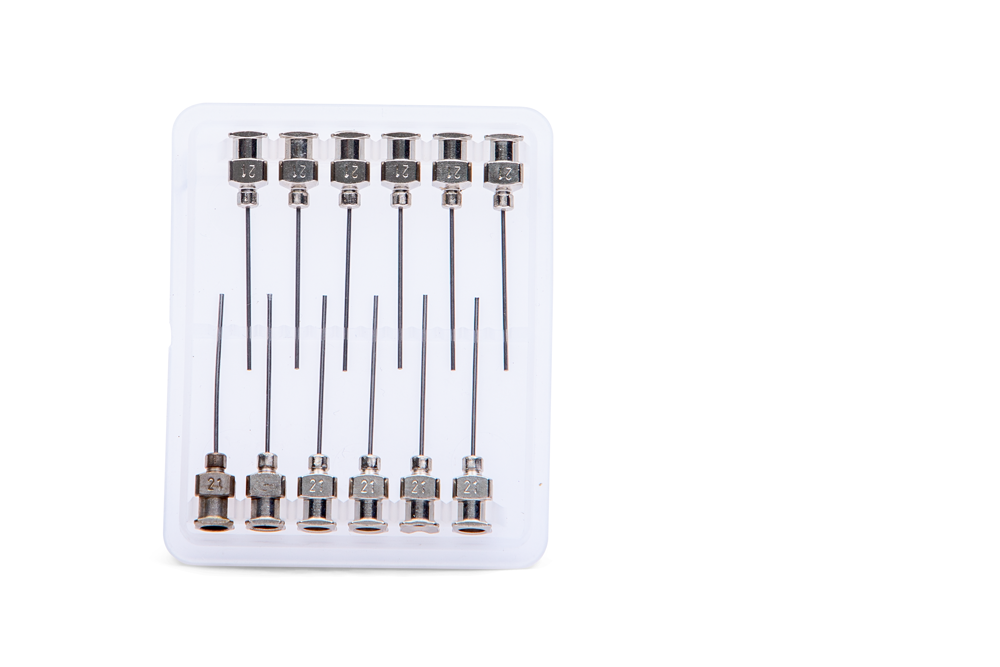
Needle diameters available: 23G (0.6 mm), 21G (0.7 mm), 19G (0.9 mm), 17G (1 mm), 15G (1.5 mm), available in stainless steel and disposable.
  • Uniform production without clogging:

Increase in the size of the fiber diameter has been associated with increase in needle diameter due to the increased droplet size at the needle tip. This happens because of the reduction of the surface tension with increasing droplet size. Therefore, low coulombic forces are required to break the surface tension and jet initiation. This results in accelerated ejection of the jet and lesser time for stretching and elongation of the fiber resulting in thicker fibers. This effect has been demonstrated by Kizildag and coworkers as they worked on Silk fibroin with needle diameters from 22G (0.70 mm) to 18G (1.25 mm) [1].  

  • Thinner fibers and higher porosity:

Smaller needle diameters tend to form fibers that are thinner, smoother and bead free as shown by the work of Bassam and coworkers who electrospun PVA/epoxy based nanofibers [2]. The reason behind getting thinner diameter nanofibers is associated with the formation of small droplet of polymer solution at the smaller diameter needle tip with high surface tension in comparison to the large needle diameter. To break this surface tension, higher electrostatic potential needs to be given which forces the jet/s and stretches the polymer to achieve smoother and thinner fibers.

References

  1. Kizildag, N., et al. Effect of needle diameter on diameter of electropsun silk fibroin nanofibers. in RMUTP International Conference: Textiles and Fashion, Bangkok, Thailand. 2012.
  2. Abunahel, B.M., N.Z.N. Azman, and M. Jamil, Effect of needle diameter on the morphological structure of electrospun n-Bi2O3/epoxy-PVA nanofiber mats. International Journal of Chemical and Materials Engineering, 2018. 12(6): p. 296-299.