

EMULSION ELECTROSPINNING
Waleed Mustafa*
*Inovenso Technology, August 2023
Daily consumables in a common man’s life mostly remain unnoticed by the users in terms of the nature of the product being utilized. This includes items such as food (ice cream), cosmetics (lotions), paints etc. On a closer look, one notices that the same principle of formation or production is being enacted to make these products which is known as emulsification and the product formed thereof, is called an emulsion [1]. These emulsions are the combination of two immiscible liquids where one liquid is entrapped with help of mechanical shear as a droplet within the other forming a semi-stable mixture. The most common form of emulsion units are water and oil. If an emulsion is left on its own, it can cause phase separation of the two immiscible liquids which is avoided by using emulsifiers or stabilizers i.e., agents that bond or keep together the two liquids by forming an interface between them.
Combining emulsions with electrospinning, which involves the charged ejection of polymer or solution using a high voltage and a spinneret to form ultrafine fibers collected on a substrate as membranes or thin sheets and other fascinating structures such as vascular grafts or scaffolds [2], would push the nano and microfiber technology into a new era of highly sophisticated and specialized materials with vast applications such as biomedical, filtration, energy generation/storage etc.
Currently, some important aspects in emulsion electrospinning are being discussed which involve the product features, material considerations and parameters followed by a brief poke in the future of emulsion electrospinning.
Mechanism and product features
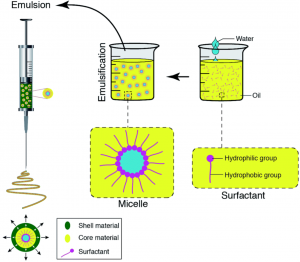
Figure 1 Emulsion electrospinning scheme (adapted from [2])
Briefly, as presented in Fig.1, when two immiscible liquids are exposed to each other such as water in oil and supported by a surfactant, which has a hydrophilic or water loving group that stays/likes water and the hydrophobic or water repelling or disliking group, then the water and oil molecules will orient themselves around this surfactant such that tiny particles or micelles will be formed with water on the inside of the micelle acting as the core of the structure while brushes protruding outside to make the micelle remain intact and afloat in the oil.
Emulsions can be electrospun with at least two different known strategies. Firstly, using a single spinneret, an emulsion solution is electrospun as the emulsion constituents participating in the formation of emulsion structure get reorganized forming a core-shell structure like the coaxial approach. Secondly, multiple spinnerets can be used where the emulsion structure allows reorientation in a core-shell fiber structure resulting in higher production rate. These strategies of stabilizing particles in a solution are being used in research for entrapping many molecules for applications such as drug delivery [2].
DEFINED PARAMETERS
General electrospinning processes and related parameters need to be understood and accounted well to get the successful fiber/emulsion formation. These parameters are important in terms of deciding the mode/s of operation of electrospinning and type of product formed thereof. Some of these parameters have been highlighted below:
Table 1. General parameters considered for electrospinning process (adapted from [3, 4].)
| General parameters | Individual parameters | Keywords |
| Electrospinning | Applied Voltage (in kilovolts) | Ease of jet formation and polymer stretching due to charge repulsion within polymer |
| Distance between collector and needle, and needle diameter | Affects morphology of fibers, deposition time, evaporation rate, whipping interval etc. | |
| Flow rate | Affects morphology of fibers, balance needed between incoming solution and outgoing via jets i.e., stable Taylor cone formation | |
| Solution | Solvent type | Affects the rate of evaporation and material solubility, high evaporation cause problems such as clogging on the needle tip. |
| Polymer concentration | Affects stretching of charged jet, low concentration could lead to fiber fragmentation before reaching collector | |
| Viscosity
| Flow of solution through the needle tip, defected fibers/clogging issues | |
| Solution conductivity | Control of Taylor cone formation and fiber diameter-no/low conductivity means no/low electrospinning-can be improved by adding salt | |
| Environment | Humidity | Fiber diameter and morphology control due to jet solidification process, porous fiber formation, and lower sized diameter with increase in humidity possible |
| Temperature | Rate of solvent evaporation, solution flow rate, fiber production |
General categories of electrospinning include needle based (single, coaxial, triaxial, multi-channel), needle-free systems with free surfaces by companies such as (open surface and hybrid technology of INOVENSO Ltd (inovenso.com/). Furthermore, other modes of electrospinning are melt, emulsion, and the most common one is solution electrospinning. Here it is important to note that for each different type of technology, the parameters stated above are applicable to all and must be optimized according to the machine scale, production rate and other machine related and electrospinning parameters.
Electrospraying: In electrospraying, a liquid is atomized into small droplets under the influence of an electric field. These droplets are typically in the micrometer to sub-micrometer size range. The main purpose of electrospraying is to produce small droplets or particles, often for applications like drug delivery, particle encapsulation, or creating uniform coatings. Both electrospraying and electrospinning are based on the principles of applying an electric field to a liquid to create fine structures, they differ in terms of the final product morphology, intended applications, and the nature of the structures they generate. Electrospraying focuses on producing small droplets or particles, while electrospinning produces nanofibers.
Apart from electrospinning, changing the parameters such as applied voltage leads to disruption of the Taylor cone and results in formation of highly charged droplets which can be optimized to form micro or nanosized particles. This process is called electrospraying and can be used for multiple applications such as incorporation of other molecules inside the core as well as in the shell [5] such as drugs for drug delivery systems and incorporate other functional materials e.g., peptides, proteins, enzymes etc., [6].
Applications: Following are stated some applications for emulsion electrospinning but are not limited to these since electrospinning is an evolving technique and more applications may appear in time.
Food industry applications: Among many applications, emulsions electrospinning has been reported to show potential in encapsulation of functional components and controlled release of bioactive components (antioxidants, vitamins, flavonoids, fatty acids etc.) for health improvement, enzyme immobilization and food packaging [7].
Drug delivery applications: For materials to be used in physiological conditions, it is preferred to use biodegradable polymers which indicates the importance of degradation and therefore, controlled release of drugs from within these polymeric structures. For this, shell structure of emulsion is important. Emulsion electrospinning thus allows sustained release of biomolecules as compared coaxial spinning, and in other cases bioavailability compared to blend spun fibers. Some important drugs that have been investigated with emulsion electrospinning include anticancer (doxorubicin, paclitaxel etc.), anti-inflammatory (ketoprofen etc.,) and antibiotics (vancomycin etc.,) [8].
Other biomedical/pharmaceutical applications: Emulsion electrospinning is very useful in delivery of some susceptible molecules that can sustain the bioactivity of certain biomolecules such as proteins, enzymes, neuronal stimulating cells etc. Other applications include development of vascular grafts by release of peptides and growth factors. Delivery of biomolecules such as heparin, VEGF, bFGF, collagen for applications including cardiac, tissue and bone engineering applications such as bone repair and tendon repair [8, 9].
ADVANTAGES AND CURRENT CHALLENGES
In terms of structure, electrospun fibers hold several advantages such as tunable fiber diameters, porosity, surface to volume ratio, morphology, and mechanical properties. Compared to coaxial spinning strategy, the formation of core-shell structures in emulsion electrospinning is possible even with a single nozzle. Using the strategy of electrospraying can allow the thin film coating of emulsions as well [10].
Despite the advantages stated above, limitations such as low throughput are a challenge but can be taken care of in terms of changes made to the system e.g., multiple needle setup. Furthermore, the challenge of finding compatibility within the core-shell materials, leaching out of entrapped molecules such as drugs, penetrating physiological fluids on exposure to biological medium etc. are challenges faced in pharmaceutical and biomedical applications. The leaching issues can be addressed using crosslinking molecules such as glutaraldehyde and chlorine dioxide on the formed fibers.
References
- Kale, S.N. and S.L. Deore, Emulsion micro emulsion and nano emulsion: a review. Systematic Reviews in Pharmacy, 2017. 8(1): p. 39.
- Nikmaram, N., et al., Emulsion-based systems for fabrication of electrospun nanofibers: Food, pharmaceutical and biomedical applications. RSC advances, 2017. 7(46): p. 28951-28964.
- Govind Kumar, S. and J. Nirmala Rachel, Electrospinning: The Technique and Applications, in Recent Developments in Nanofibers Research, K. Maaz and C. Samson Jerold Samuel, Editors. 2022, IntechOpen: Rijeka. p. Ch. 1.
- Haider, A., S. Haider, and I.-K. Kang, A comprehensive review summarizing the effect of electrospinning parameters and potential applications of nanofibers in biomedical and biotechnology. Arabian Journal of Chemistry, 2018. 11(8): p. 1165-1188.
- Rostamabadi, H., et al., Electrospraying as a novel process for the synthesis of particles/nanoparticles loaded with poorly water-soluble bioactive molecules. Advances in Colloid and Interface Science, 2021. 290: p. 102384.
- Tanhaei, A., et al., Electrospraying as a novel method of particle engineering for drug delivery vehicles. Journal of Controlled Release, 2021. 330: p. 851-865.
- Zhang, C., F. Feng, and H. Zhang, Emulsion electrospinning: Fundamentals, food applications and prospects. Trends in Food Science & Technology, 2018. 80: p. 175-186.
- Buzgo, M., et al., 11 – Blend electrospinning, coaxial electrospinning, and emulsion electrospinning techniques, in Core-Shell Nanostructures for Drug Delivery and Theranostics, M.L. Focarete and A. Tampieri, Editors. 2018, Woodhead Publishing. p. 325-347.
- McClellan, P. and W.J. Landis, Recent Applications of Coaxial and Emulsion Electrospinning Methods in the Field of Tissue Engineering. BioResearch Open Access, 2016. 5(1): p. 212-227.
- Khan, M.K.I., et al., Electrospraying of water in oil emulsions for thin film coating. Journal of Food Engineering, 2013. 119(4): p. 776-780.